How to Declutter a Victorian Terrace Hallway in a Weekend
A Victorian terrace hallway looks lovely in an estate agent's photograph: high ceiling, a strip of original tile, a curve of cornicing above. In practice it is often under a metre wide, has no cupboard, and absorbs everything a busy household can throw at it. It is the hardest-working and least generous space in the house. Two days is enough to sort it — not with more storage, but by deciding what the hall is for and refusing to let it be anything else.
The mistake most people make is treating the hallway as a general-purpose room. It becomes a waiting room for charity bags, a workshop for half-finished DIY, a kennel for the dog's entire toy collection. None of that is storage. It is delay, wearing a coat.
Start by Measuring, Not Shopping
Before you buy a single hook, spend twenty minutes with a tape measure. Victorian hallways vary more than people expect: some are 85cm wide, others a comfortable 1.2m, and that difference decides what will fit. A 35cm-deep shoe bench that looks modest online will have you shuffling sideways every morning in an 85cm hall; in a 1.2m one it is barely noticeable.
- Width at the narrowest point, allowing for skirting and any radiator.
- How far the front door swings when it opens inwards.
- The height of your dado rail or picture rail, if you have them.
- Ceiling height — a 2.9m ceiling is free storage.
- Where the light switch, meter cupboard and any original tile border sit.
Then write down the hall's single job: moving people out of the door and back in again with the least fuss. Anything that does not serve that job is parked, not stored. Keep that sentence on your phone while you work — it is what stops you buying a console table you have nowhere to put.
Empty It Completely
You cannot sort a hallway while standing in it. Spread a sheet on the kitchen or living room floor and carry everything out: coats, shoes, bags, leads, post, the box of bulbs nobody has opened for years.
Sort into three piles and be firm about the third.
- Back in the hall. Only what is used most days — the coat you actually wear, school shoes, keys, the dog lead.
- Lives somewhere else. Winter coats, tools, the bike helmet that belongs in the shed.
- Leaves the house. Charity bag, recycling, bin. Put it in the car now, not by the front door.
While the floor is clear, wash it, wipe the skirting and check the walls for cracks or damp. A grubby hall makes even good storage look like clutter, and a coat of paint on a narrow hall is the cheapest square footage you will ever gain.
If an item has no home of its own, the hallway becomes its home by default. That is how the pile starts.
Coat Storage for a Narrow Hall
Most Victorian terraces have nowhere near enough hanging space. The answer is height, and keeping the walking line clear.
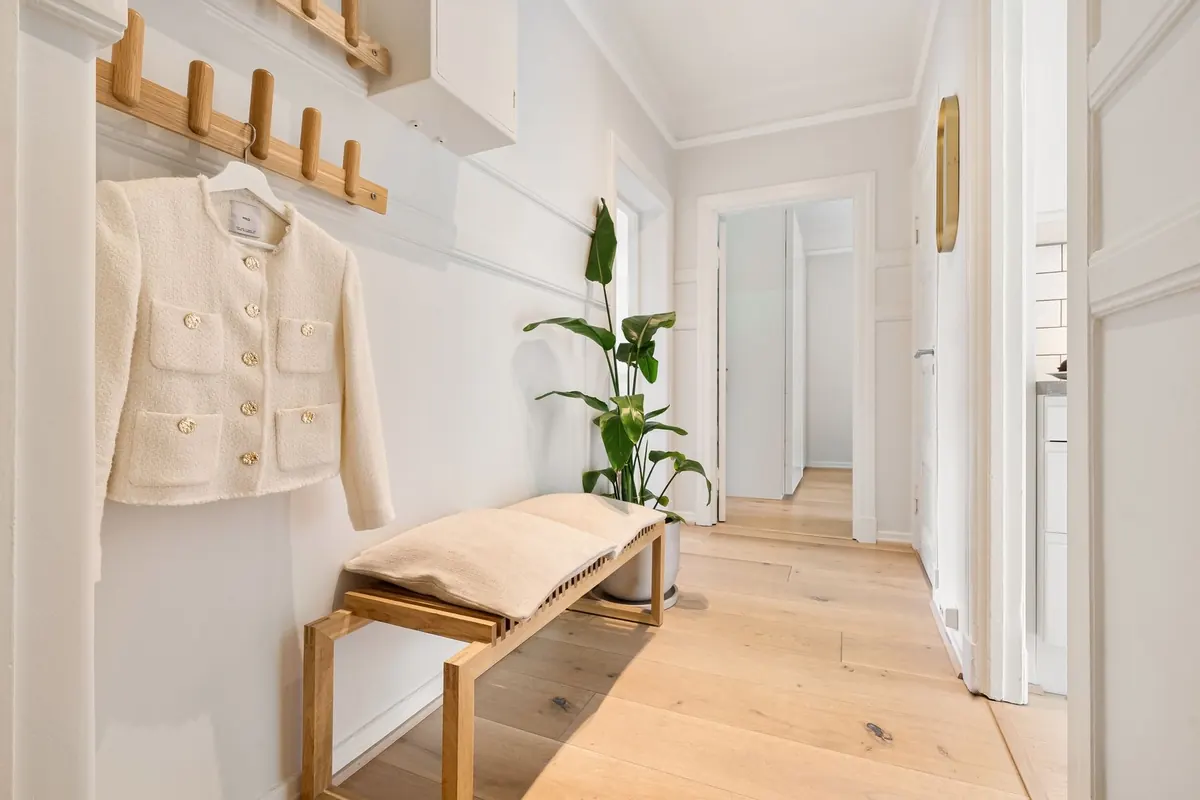
A wall-mounted rail with individual hooks works better than a freestanding hall tree in any hall under a metre wide. Fit it at about 1.65–1.75m, so long coats clear the floor and shorter people can still reach. If the ceiling is high, add a second rail at 2m for guests' jackets and out-of-season coats. Two rails of five hooks will beat one bulging rail of twelve every time — hooks are only useful if a coat can actually hang flat on them.
- One coat per person by the door, plus one spare hook for guests.
- Choose hooks with a wide, rounded shape; narrow pegs split linings and let coats slide.
- Fix into studwork or use proper plasterboard anchors — Victorian lath and plaster will not hold a loaded rail on raw plugs alone.
- Keep the rail short enough that a coat does not brush against the door frame as it opens.
Shoes, Bags and the Dropping Zone
Shoes are what defeat most hallways, because they arrive in pairs but get kicked off singly. Decide on a limit and design around it: two pairs per person in daily rotation, stored on a slim rack or a shallow bench with a lift-up lid. Everything else lives in a bedroom or under a bed.
For bags, a single hook per person at about 1.2m, just under the coats, keeps school bags and handbags off the floor without adding furniture. If you have a meter cupboard, clear it out and reclaim it — painted, with hooks inside the door, it will swallow keys, leads and spare bulbs invisibly.
Light, Colour and Making a Small Hall Feel Bigger
A long, narrow hall with one dim bulb will feel tight no matter how tidy it is. A warm-white bulb at 2700K, around 800–1000 lumens, immediately makes the space look wider. Put the main light on a two-way switch if you can, so nobody has to walk back through a dark hall.
Colour is doing the heavy lifting here. Pale shades — off-white, soft stone, the palest sage — reflect light down the corridor. Keep the strongest colour above the dado rail or on the front door, not on four walls. If you have original encaustic tiles, do not cover them with a runner unless the surface is genuinely damaged; a strip of tile is one of the few period features a narrow hall can show off.
The Weekend Plan
Saturday
- Measure, photograph and write down the hall's single job.
- Empty the hall completely onto a sheet.
- Sort into three piles and put the third pile in the car.
- Clean the floor, skirting and walls; fill and sand any cracks.
- Shop with your measurements in hand, not your wish list.
Sunday
- Paint the walls if you are painting, and let them dry properly.
- Fit the coat rail, shoe rack and any bag hooks at the heights you planned.
- Return only the everyday items, one per person, and label nothing unless it genuinely helps.
- Walk in through the front door with your arms full and check you can still get past.
The Five-Minute Reset
Decluttering a hallway is not a weekend's work; it is a weekend followed by a habit. Once a day, give it five minutes: coats on hooks, shoes in pairs, post opened and binned or filed, bags hung. Anything without a home goes upstairs or outside rather than being placed on the floor "just for now".
Do that and the hall stops being the room you apologise for. Two days of measuring, emptying and refusing to store things that belong elsewhere will hold for years — as long as you keep the hall doing the one job you wrote down for it.
Photo: Lisa Anna / Pexels